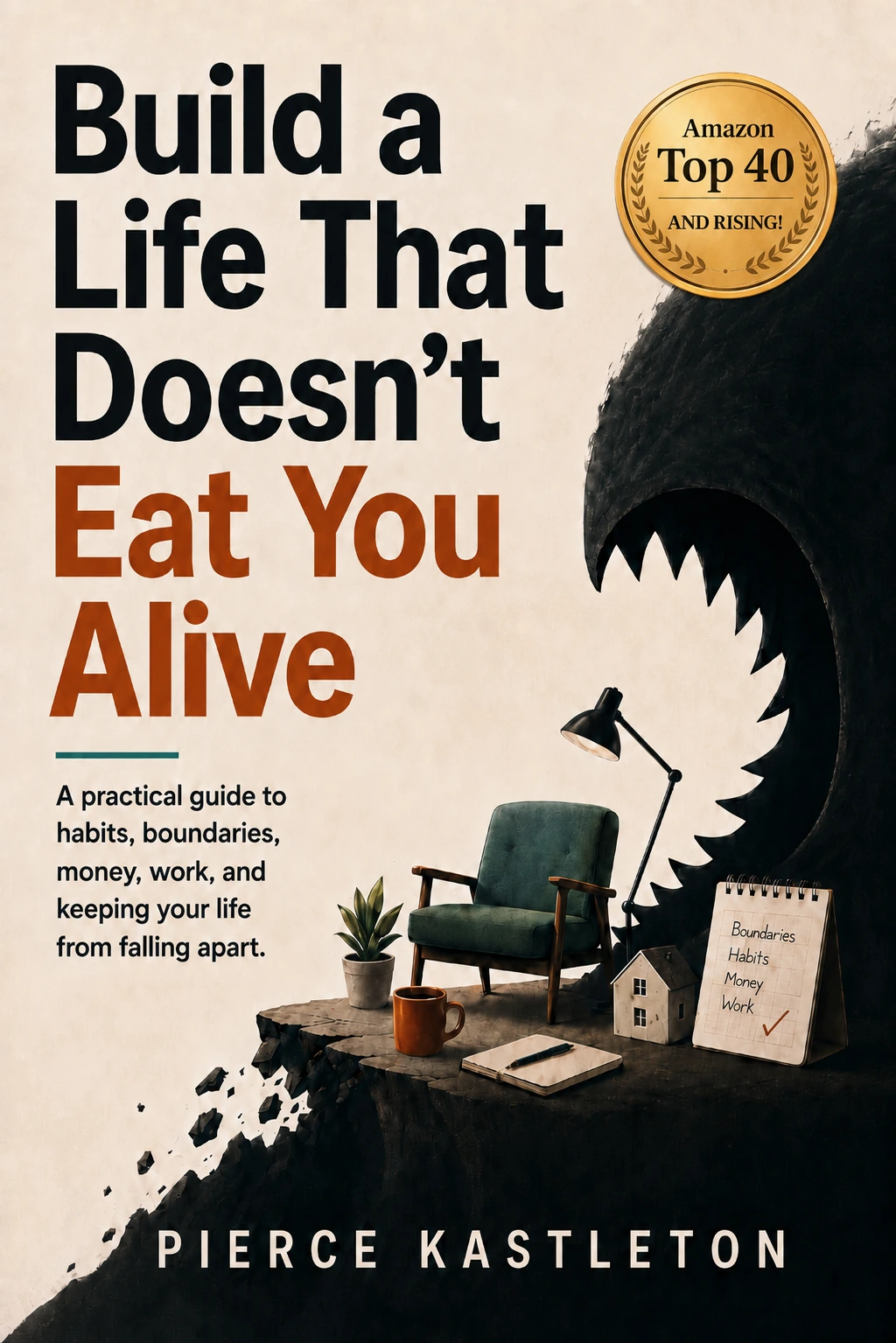
Book sample
Read the first pages before you buy.
The sink gave up before I did.
This felt rude. I had given it years of plates, coffee mugs, and the occasional suspicious spoon. In return, I asked only that it swallow water and not become a small inland sea. But one Tuesday night it made a wet, final sound, then began sending gray water back into the world like a vengeful oracle.
I stood there holding a sponge, surrounded by dishes, unpaid bills, two bags of laundry, three unanswered messages from people I liked, and one email marked urgent by someone who had clearly never seen a corpse and therefore had no sense of scale.
The sink was not the problem.
The sink was the place where the problem became visible.
Most people do not wake up one day with a destroyed life. They wake up with a sock on the floor, then a second sock, then a bank alert, then an unopened letter, then a calendar that looks like it was designed by a committee of enemy squirrels. One small thing goes feral. Then another. Eventually your life starts making a noise.
This book is about that noise.
Read the full introduction
Introduction: The Sink Gave Up First
The sink gave up before I did.
This felt rude. I had given it years of plates, coffee mugs, and the occasional suspicious spoon. In return, I asked only that it swallow water and not become a small inland sea. But one Tuesday night it made a wet, final sound, then began sending gray water back into the world like a vengeful oracle.
I stood there holding a sponge, surrounded by dishes, unpaid bills, two bags of laundry, three unanswered messages from people I liked, and one email marked urgent by someone who had clearly never seen a corpse and therefore had no sense of scale.
The sink was not the problem.
The sink was the place where the problem became visible.
Most people do not wake up one day with a destroyed life. They wake up with a sock on the floor, then a second sock, then a bank alert, then an unopened letter, then a calendar that looks like it was designed by a committee of enemy squirrels. One small thing goes feral. Then another. Eventually your life starts making a noise.
This book is about that noise.
It is about the low hum of avoided decisions. The stale air of rooms you mean to clean. The private shame of pretending you are fine while your inbox has become a mass grave for opportunities. It is about wanting to be better, trying to be better, then discovering that wanting is a charmingly useless fuel source by itself.
Wanting will not wash your dishes. Wanting will not call the dentist. Wanting will not explain to your future self why you spent forty-seven minutes researching the best notebook for productivity instead of doing the one task written on the back of an envelope.
Wanting is a match. Systems are the stove.
The better-selling how-to books of our age tend to orbit a few ancient truths: make change small, stop fighting reality, take responsibility without making shame your landlord, protect your attention, and understand that money is mostly behavior wearing a little hat. These ideas sell because they are true. They also sell because most of us keep trying to build a life out of intentions, vibes, and the occasional Sunday-night panic.
This book takes those useful truths and drags them into a slightly darker room. Not because life is hopeless, but because false cheer is exhausting. If your life feels like it has teeth, being told to “rise and grind” is not encouragement. It is seasoning.
So let us be honest.
You are going to die.
Not today, probably. If you are reading this in a haunted mine shaft, adjust accordingly. But eventually. The end exists. Your hours are not infinite. Your attention is not infinite. Your patience is not infinite. Your closet space is definitely not infinite, though many of us behave as if death itself can be postponed by buying another storage bin.
The point of remembering mortality is not to make you gloomy. You already know how to be gloomy; you have the internet. The point is to clarify the stakes.
A life is made out of repeated days. A day is made out of repeated choices. A choice is often made easier or harder by the room, the people, the default, the friction, the fear, the calendar, and the story you tell yourself at the exact moment you are tired enough to believe nonsense.
Change, then, is not about becoming a superior species. It is about editing the conditions that produce your days.
Think of your life as a house. Some rooms are lovely. Some are storage closets full of emotional raccoons. Some doors should be locked. Some windows should be opened. The basement may contain something with glowing eyes, but we will get to your finances in Chapter 6.
You do not fix a house by standing in the hallway screaming, “I should be a mansion.” You fix it by finding the leak. Then the rot. Then the loose step that has tried to murder you every morning since March.
This book is a renovation manual for the non-structural collapse of being alive.
We will begin with triage. Not the glamorous kind. There will be no montage. You will not emerge from a lake holding a sword. You will make a list. You will look at what is draining you. You will choose what matters now and what can be allowed to die quietly in a ditch.
Then we will build small systems: habits, home defaults, money rituals, boundaries, work practices, relationship repairs, and rest that is not just unconscious scrolling with crumbs on your shirt.
Every chapter has three parts:
- The ugly truth — the thing people often pretend is not true because it is uncomfortable, obvious, or bad for branding.
- The useful move — the practical action that makes the problem smaller.
- The field exercise — a small assignment that lets you test the idea without turning your life into a motivational hostage situation.
By the end, you will not have a perfect life. Excellent. Perfect lives are brittle and attract cult leaders. You will have a more survivable life, a clearer set of priorities, fewer avoidable disasters, and a repeatable way to restart when you inevitably become, as all humans sometimes do, a damp bag of poor decisions.
Let us begin where all good horror stories begin.
With an inventory.